Headlights are the primary visual connection between your car and the dark road ahead. As automotive technology has evolved, headlight systems have transformed from basic illumination devices into highly advanced lighting technologies. Today, drivers shopping for replacement bulbs or full headlight assembly upgrades are met with three primary options: Halogen, Xenon HID (High-Intensity Discharge), and LED (Light Emitting Diode).
Each lighting technology comes with its own unique set of strengths, limitations, power requirements, and price points. Choosing the right headlight technology depends heavily on your driving habits, budget, visual preferences, and vehicle compatibility.
In this comprehensive guide, we will break down the mechanics, pros, cons, and performance characteristics of Halogen, Xenon HID, and LED headlights to help you determine which lighting setup is best suited for your car.
1. Halogen Headlights: The Traditional Workhorse
Halogen headlights have been the industry standard for decades. They function similarly to traditional incandescent household bulbs: an electric current passes through a fine tungsten filament inside a compact glass capsule filled with halogen gas (typically iodine or bromine).
[Electrical Current] ──> [Tungsten Filament] ──> [Incandescent Glow] + [Halogen Gas Reaction]
Key Characteristics
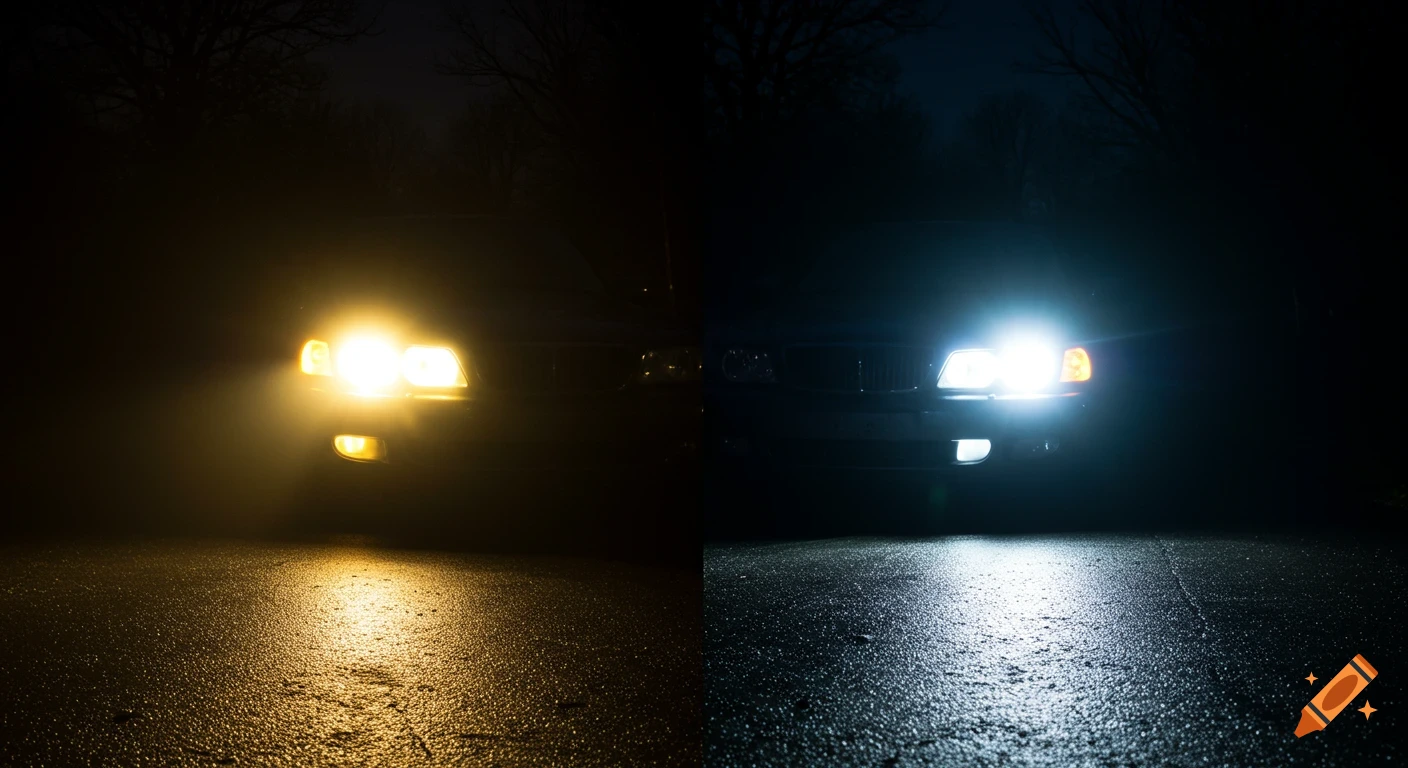
- Color Temperature: Warm yellow / amber hue (approximately 3000K – 4000K).
- Light Output: Moderate output, usually ranging between 700 to 1,200 lumens.
- Operating Temperature: Generates significant heat during operation.
Advantages
- Low Initial Cost: Halogen bulbs are exceptionally inexpensive to produce, purchase, and replace.
- Universal Compatibility: Available in nearly every standard socket configuration for older and modern vehicles alike.
- Simple Installation: “Plug and play” simplicity; replacing a blown halogen bulb takes only a few minutes with basic tools.
Disadvantages
- Shorter Lifespan: Due to heat generation and physical filament wear, halogens typically last only 500 to 1,000 hours.
- Energy Inefficiency: A large percentage of the electrical energy consumed is wasted as heat rather than converted into usable light output.
- Limited Brightness & Range: Offers shorter beam throw and dimmer visibility compared to modern HID and LED options.
2. Xenon HID Headlights: High-Intensity Arc Illumination
Introduced in premium luxury vehicles in the 1990s, Xenon HID (High-Intensity Discharge) technology abandoned the traditional metal filament altogether. Instead, HID bulbs produce light by creating an electric arc between two electrodes inside a sealed glass tube filled with xenon gas and metal halide salts.
[High-Voltage Ballast] ──> [Electric Arc Between Electrodes] ──> [Ignited Xenon Gas Arc]
Key Characteristics
- Color Temperature: Bright cool white to blueish tint (ranging from 4300K to 8000K).
- Light Output: Exceptionally high intensity, often producing 3,000 to 3,200 lumens per bulb.
- Component Requirements: Requires a high-voltage ballast to ignite and regulate electrical current.
Advantages
- Exceptional Brightness & Throw: HIDs produce a powerful, wide beam pattern that projects further down unlit roads than standard halogens.
- Better Energy Conversion: Produces significantly more light per watt of electricity than halogen bulbs.
- Longer Lifespan: With no fragile filament to break, HID bulbs last around 2,000 to 3,000 hours.
Disadvantages
- Warm-up Delay: HIDs require several seconds after turning on to reach full ignition brightness.
- Complex Setup: Requires external ballasts and igniters, making installation or conversion more complex.
- Glare Risk: If installed in reflector housings not designed for HID arcs, they can cause blinding glare for oncoming drivers.
3. LED Headlights: The Modern Standard
LED (Light Emitting Diode) technology represents the current peak of automotive lighting engineering. LEDs generate light through solid-state physics: electrons move through a semiconductor material, releasing energy in the form of bright light photons.
[Electrical Power] ──> [Semiconductor Microchip] ──> [Solid-State Photon Emission]
Key Characteristics
- Color Temperature: Crisp pure white (typically 5000K – 6500K).
- Light Output: High intensity, ranging from 2,500 to 6,000+ lumens per set.
- Efficiency: Converts nearly all electrical energy directly into light with minimal power draw.
Advantages
- Instant Illumination: Reaches 100% brightness instantaneously without warm-up time.
- Extreme Longevity: Rated to last anywhere from 30,000 to 50,000+ hours—often outlasting the lifespan of the vehicle itself.
- Energy Efficiency: Draws less power from your vehicle’s battery and alternator setup.
- Sharp Cutoff Line: Delivers focused light projection when fitted into proper projector optics.
Disadvantages
- Higher Upfront Investment: Quality LED bulbs and conversion kits cost more initially than halogen replacements.
- Heat Dissipation Needs: While the light beam is cool, the back of the microchip generates heat, requiring built-in cooling fans or heatsinks.
Head-to-Head Comparison Table
| Feature / Metric | Halogen | Xenon HID | LED |
| Technology | Filament & Gas | Gas Discharge Arc | Solid-State Semiconductor |
| Average Lifespan | 500 – 1,000 Hours | 2,000 – 3,000 Hours | 30,000 – 50,000+ Hours |
| Lumen Output | Low (~1,000 Lumens) | Very High (~3,200 Lumens) | High to Extreme (3,000+ Lumens) |
| Power Consumption | High (~55W) | Moderate (~35W) | Low (~20W–35W) |
| Warm-up Time | Instant | 3 to 7 Seconds | Instant |
| Installation | Easiest | Moderate / Complex | Easy to Moderate |
Which Headlight Technology Should You Choose?
Choose Halogen If: You are on a tight budget, drive primarily in well-lit urban environments, or want a simple drop-in replacement without altering factory electrical harnesses.
Choose Xenon HID If: You frequently travel on pitch-black rural highways, want maximum long-distance beam projection, and don’t mind a brief warm-up delay when switching on your lights.
Choose LED If: You want the best overall combination of high brightness, instant power, modern pure-white aesthetics, low energy consumption, and long-term durability.
Conclusion
Upgrading your headlights is one of the most practical and immediate improvements you can make to enhance road safety, night visibility, and overall vehicle aesthetic. While halogen bulbs remain a budget-friendly baseline, LED headlights have emerged as the clear winner for modern drivers seeking longevity, energy efficiency, and instant crystal-clear road illumination.